In this article
Ask ChatGPT for “the best CRM for a small agency” and it won't show ten blue links. It names three or four products, says a line about each, and the person asking often stops there. If your product isn't in that answer, you weren't on page two. You weren't there at all.
That's the problem AI visibility tools solve. They ask ChatGPT, Gemini, Perplexity and Google's AI answers the questions your buyers ask, every day, and record whether your brand comes up, where it sits next to competitors, and which websites the AI used as its source.
We compared nine of them: what each one tracks, what it costs once you get past the entry plan, and who it suits. One thing to know up front: most “best AI visibility tools” articles are written by companies that sell one, and they put themselves first. TechZTalk doesn't sell an AI visibility tool, so nobody here gets the top spot by default.
Key takeaways
- Cheapest way in: Otterly.AI Lite at $29/month (15 prompts) or HubSpot AEO at $50/month. HubSpot's one-off AI Search Grader is free.
- Most prompts for the money: SE Visible tracks 200 prompts for $99/month, far more than most rivals at that price.
- Already pay for Semrush or Ahrefs? Start with their AI add-ons. You keep SEO and AI data in one place.
- Bigger teams and agencies: Peec AI, Profound and Scrunch cover more engines and more seats, at $245–$500+/month.
- Before you pay anything, run the free 30-minute manual check further down. It tells you whether you have a problem worth tracking.
Quick answer: which AI visibility tool should you pick?
| If you are… | Start with | Why |
|---|---|---|
| A founder checking for the first time | HubSpot AI Search Grader (free), then Otterly.AI Lite | Free snapshot first, then 15 tracked prompts for $29 |
| A small marketing team on a budget | SE Visible | 200 prompts and unlimited users from $99/month |
| Already using Semrush | Semrush AI Visibility Toolkit | Adds AI tracking next to your keyword data |
| Already using Ahrefs | Ahrefs Brand Radar | See any brand's AI visibility, competitors included, without setting up prompts |
| A growing SaaS team | Peec AI | Clean daily tracking, unlimited seats, you pick the AI models |
| An agency with many clients | Peec AI or Scrunch | Several projects per plan; Scrunch includes 350 prompts on its entry plan |
| An enterprise brand | Profound or AthenaHQ | Widest engine coverage and the deepest analysis |
What is an AI visibility tool, exactly?
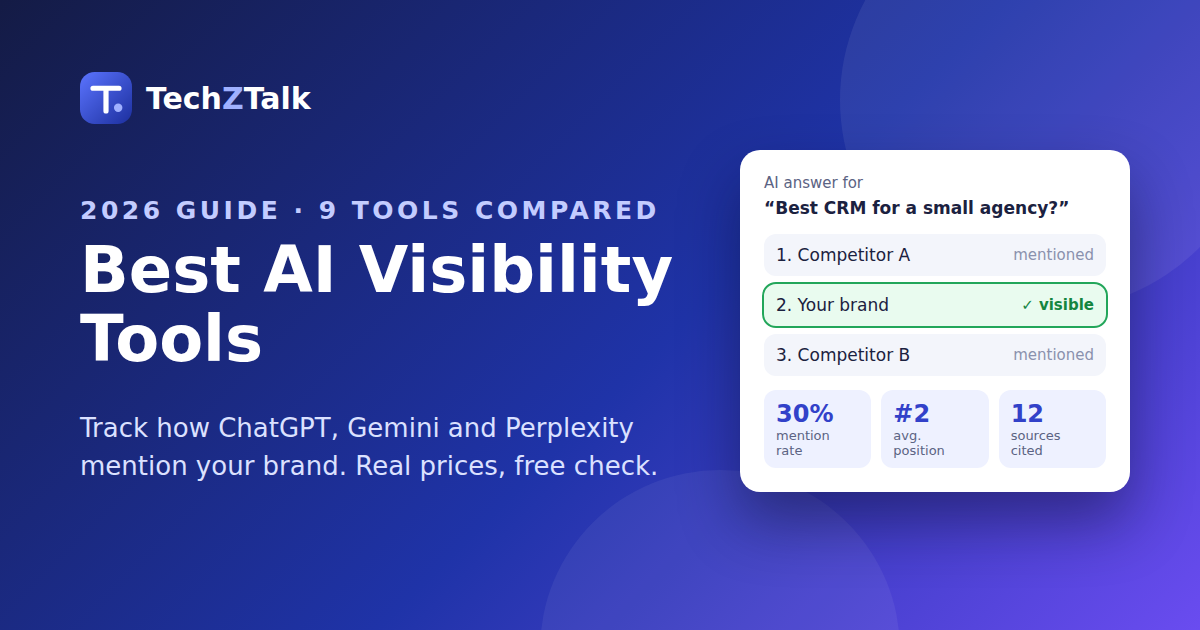
Think of it as rank tracking for AI answers. In SEO you track keywords; here you track prompts, the full questions people type into an assistant, like “what's the best project management tool for a remote team of 10?”
The tool sends those prompts to each AI engine on a schedule (usually daily), saves the answers and pulls out a few numbers:
- Mention rate (visibility): the share of answers that name your brand. If you appear in 12 of 40 answers, that's 30%.
- Share of voice: your mentions compared with competitors' mentions for the same prompts.
- Position: whether you're named first, third or last. First matters, the same way it does in search results.
- Citations (sources): the web pages the AI linked or relied on. Often the most useful report, because it tells you where to show up: review sites, directories, Reddit threads, comparison articles.
- Sentiment: whether the AI describes you positively, neutrally or with caveats like “expensive” or “limited support”.
Note: AI answers change from one run to the next. Ask the same question twice and you can get a different list. That's why these tools ask every prompt repeatedly and report trends. A single screenshot proves very little, in either direction.
AI visibility tools compared: prices and limits
Prices below come from each vendor's pricing page in October 2026, except where marked “reported”: those come from published comparisons because the vendor's own page didn't show the figure. “Prompts” means the number of questions tracked, not the number of checks.
| Tool | Entry price | Prompts on entry plan | AI engines on entry plan | Free option |
|---|---|---|---|---|
| Otterly.AI | $29/mo | 15 | ChatGPT, AI Overviews, Perplexity, Copilot | Free trial |
| HubSpot AEO | $50/mo | Prompt block (reported: 25) | ChatGPT, Perplexity, Gemini | Free one-off AI Search Grader |
| Peec AI | $95/mo | 50 | Any 3 you choose | Free trial |
| SE Visible | $99/mo | 200 | ChatGPT, Gemini, AI Mode, AI Overviews | 10-day trial |
| Semrush AI Visibility Toolkit | $99/mo per domain | 25 | ChatGPT, Google AI, Gemini, Perplexity | No trial for the toolkit |
| Profound | $99/mo, billed yearly (reported) | 50 | ChatGPT only | Demo |
| Ahrefs Brand Radar | From $199/mo (AI Visibility Index) | Index of ready-made prompts + custom prompts | 6 platforms; Claude on custom prompts | Free AI visibility checker |
| Scrunch | $300/mo ($250 yearly, reported) | 350 | Not stated on entry plan | 7-day trial |
| AthenaHQ | $295/mo | Credit-based (3,600 answers/mo) | 11 models | Free Essential plan |
What a tracked prompt really costs
Entry prices hide a lot. A $29 plan with 15 prompts and a $99 plan with 200 prompts are very different deals. Here's the monthly price divided by the prompts included:
| Plan | Price | Prompts | Cost per prompt |
|---|---|---|---|
| SE Visible Basic | $99 | 200 | about $0.50 |
| Scrunch Starter (reported) | $300 | 350 | about $0.86 |
| Peec AI Pro (reported) | $245 | 150 | about $1.63 |
| Otterly.AI Standard | $189 | 100 | about $1.89 |
| Peec AI Starter | $95 | 50 | about $1.90 |
| Otterly.AI Lite | $29 | 15 | about $1.93 |
| Profound Starter (reported, ChatGPT only) | $99 | 50 | about $1.98 |
| Semrush AI Visibility Toolkit | $99 | 25 | about $3.96 |
| Profound Growth (reported) | $399 | 100 | about $3.99 |
Cost per prompt isn't the whole story. One prompt checked across four engines gives you four times the data of a prompt checked on one. Still, it's the quickest way to see who is cheap at the start and expensive later.
The 9 best AI visibility tools in 2026
1. Otterly.AI — best low-cost starting point
- Best for: founders, freelancers and small teams who want real tracking without a big bill
- Pricing: Lite $29/mo (15 prompts), Standard $189/mo (100 prompts), Premium $489/mo (400 prompts); about 15% off yearly
- Standout feature: four engines on every plan, including Microsoft Copilot
Otterly is the easiest way to stop guessing. Add your brand, your competitors and a handful of buyer questions, and within a day you can see who ChatGPT, Google's AI Overviews, Perplexity and Copilot recommend. The jump from Lite to Standard is steep, though. Gemini, Google AI Mode and Claude are paid add-ons rather than included.
Pros
- Lowest paid entry price on this list
- Copilot included, which many rivals skip
- Simple to set up
Cons
- 15 prompts on Lite is only enough for a first look
- Gemini, AI Mode and Claude cost extra
2. SE Visible — best value for small marketing teams
- Best for: small teams and agencies that need lots of prompts on a modest budget
- Pricing: Basic $99/mo (200 prompts, 3 projects), Core $189/mo (450 prompts), Plus $355/mo (1,000 prompts); 20% off yearly
- Standout feature: 200 prompts and unlimited users on the entry plan
SE Visible is SE Ranking's standalone AI visibility product. You don't need an SE Ranking subscription to use it. The headline is volume: 200 prompts for $99 lets you track a whole buying journey, from “what is…” questions to “X vs Y” comparisons, instead of five vanity prompts. It shows sentiment, competitor share and the URLs the AI cites, and has an API.
Pros
- Lowest cost per prompt we found
- Unlimited users and CSV export
- 10-day free trial
Cons
- No Perplexity or Claude yet (Claude is listed as planned)
- Seven countries and five languages, so check yours
3. Peec AI — best focused tool for growing SaaS teams
- Best for: in-house marketing teams that want clean daily data and room to grow
- Pricing: Starter $95/mo (50 prompts), Pro $245/mo (150 prompts), Advanced from $495/mo (350 prompts); 15% off yearly
- Standout feature: you choose which 3 AI models to track; unlimited seats on every plan
Peec does one job and does it well. You pick the three engines that matter to your buyers, maybe ChatGPT, AI Overviews and Perplexity for a B2B tool, and get daily visibility, position, sentiment and source reports. Unlimited seats help: the whole team can log in without a bigger bill. Extra engines cost more, and Enterprise reaches a dozen-plus models, including Claude, Grok and DeepSeek.
Pros
- Unlimited seats from Starter up
- Flexible choice of AI models
- Strong source and citation reports
Cons
- Only 3 engines on self-serve plans
- Tracking only, no content-writing features
4. Semrush AI Visibility Toolkit — best if you already use Semrush
- Best for: SEO teams that live in Semrush
- Pricing: $99/mo per domain (25 prompts); extra 50 prompts for $60/mo
- Standout feature: prompt research, which works like keyword research for AI questions
The toolkit tracks ChatGPT, Google's AI results, Gemini and Perplexity. The part we'd actually use most is Prompt Research: it suggests the questions people ask in your topic, with volume and intent, which saves you inventing a prompt list from scratch. It also includes an AI search site audit that flags pages AI crawlers can't read. The catch is the 25-prompt limit, the tightest on this list for the price.
Pros
- AI and SEO data side by side
- Prompt research saves hours of guesswork
- Site audit checks for AI crawler problems
Cons
- Only 25 tracked prompts per domain
- No free trial for the toolkit itself
5. Ahrefs Brand Radar — best for spying on competitors
- Best for: Ahrefs users and anyone doing competitor research
- Pricing: AI Visibility Index from $199/mo; custom prompt tracking included with paid Ahrefs plans, larger prompt packs from $50/mo
- Standout feature: a ready-made index, so you can look up any brand's AI visibility without setting anything up
Most tools only know about prompts you add. Brand Radar works differently: Ahrefs runs a large set of prompts across AI Overviews, AI Mode, ChatGPT, Perplexity, Gemini and Copilot, so you can type in a competitor's name and see where they appear, today. Custom prompts add your own questions, with Claude available there too. Each custom prompt also shows the background searches the AI ran, which is a handy way to spot content gaps.
Pros
- Instant data on any brand, yours or a rival's
- Six AI platforms in the index
- Free AI visibility checker to preview
Cons
- Needs an Ahrefs subscription for the full product
- Pricing has several moving parts
6. HubSpot AEO — best for HubSpot users and tight budgets
- Best for: small businesses, especially those already on HubSpot
- Pricing: $50/mo, no HubSpot subscription needed; included in Marketing Hub Pro and Enterprise. The AI Search Grader is free.
- Standout feature: a free one-off brand check with a score out of 100
Start with the free AI Search Grader. Enter your brand and it scores how ChatGPT, Perplexity and Gemini describe you, broken down into sentiment, presence, recognition, share of voice and competition. No account needed. If the result worries you, HubSpot AEO turns that one-off check into ongoing prompt tracking with competitor comparisons and recommendations.
Pros
- Useful free grader, no account needed
- Low monthly price
- Free for Marketing Hub Pro and Enterprise customers
Cons
- Three engines only
- Less depth than dedicated tools
7. Profound — best for enterprise brands
- Best for: large brands with a dedicated SEO or brand team
- Pricing (reported): Starter $99/mo, Growth $399/mo, both billed yearly; Enterprise on quote
- Standout feature: up to 9–10 answer engines on Enterprise, plus detailed AI crawler data
Profound is the name you hear most in enterprise circles. The self-serve plans are limited, though: Starter tracks ChatGPT only and Growth adds two more engines for 100 prompts. The real product is Enterprise, with wide engine coverage, multiple countries and languages, and analysis of how AI crawlers visit your site. Great if you have the budget and the team. Overkill for a startup.
Pros
- Widest engine coverage at the top tier
- Deep reports for large teams
Cons
- Self-serve plans are annual-only
- Entry plan covers ChatGPT only
8. Scrunch — best for agencies tracking many prompts
- Best for: agencies and mid-size brands that want lots of prompts and page-level checks
- Pricing (reported): Starter $300/mo or $250/mo yearly (350 prompts, 3 seats); Growth $500/mo (700 prompts, 5 seats)
- Standout feature: buyer personas and page audits alongside tracking
Scrunch gives you a big prompt allowance from the start, plus a library of ready-made industry prompts. You can track visibility by persona, say “IT manager” versus “founder”, and audit pages for AI readability. Sitecore bought Scrunch in June 2026, so expect closer ties to Sitecore's content platform over time.
Pros
- 350 custom prompts on the entry plan
- Persona-based tracking
- 7-day trial, no card needed
Cons
- $300/month is a big step for small teams
- Product direction may shift after the acquisition
9. AthenaHQ — best free plan for trying many AI models
- Best for: teams that want broad model coverage and to try before paying
- Pricing: Essential free; Starter $295/mo (3,600 credits, 11 models); Enterprise on quote
- Standout feature: 11 AI models on Starter, with unlimited team members
AthenaHQ charges by credits, roughly one credit per AI answer, rather than by prompt. That's flexible: track a few prompts on many models, or many prompts on a few. The free Essential plan lets you see the product with real data before committing. Watch your credit use, though. Daily tracking across 11 models eats credits fast.
Pros
- Free plan to start
- 11 models, including Claude, on Starter
- Unlimited team members
Cons
- Credits make monthly costs harder to predict
- API access is an extra
Check your AI visibility for free in 30 minutes
Before you pay for anything, do this once by hand. It's how most teams find out whether they have a problem at all.
- Write 15–20 buyer questions. Mix three kinds: category questions (“best invoicing software for freelancers”), comparison questions (“[your brand] vs [competitor]”) and problem questions (“how do I stop clients paying late?”). Write them the way a customer would, not the way your marketing team would.
- Ask them in ChatGPT, Gemini and Perplexity. Use a fresh chat each time. Personal memory and past chats can change the answer.
- Log five things in a spreadsheet: were you mentioned (yes/no), your position in the list, which competitors appeared, which sources were cited, and how you were described.
- Repeat once or twice on another day. Answers move around, so a pattern over a few runs matters more than any single result.
- Read the sources column carefully. If the same review site, directory or Reddit thread keeps appearing, that's where you need to be.
Tip: If you're missing from most answers, a tracking tool is worth the money. If you show up in nearly all of them, check again monthly by hand and spend the budget on content instead.
How to choose the right AI visibility tool
- Start from your buyers' AI habits, not the feature list. B2B software buyers lean on ChatGPT and Perplexity; consumer brands need Google's AI Overviews and AI Mode. Pay for the engines your buyers use.
- Count prompts honestly. Five prompts tell you very little. Plan for at least 30–50 covering categories, comparisons and problems, and price the plan that fits that number.
- Make sure the source reports are good. Knowing you're invisible is step one. Knowing which pages the AI trusts is what tells you what to do next.
- Use what you already pay for. If Semrush, Ahrefs or HubSpot is already in your stack, try its AI add-on before buying another login.
- Use the trials properly. Load the same prompt list into two tools during their trials and compare the results with your manual check. The one that matches reality wins.
Watch out: Prompt limits and engine add-ons are where costs creep up. A plan that looks cheap can double once you add Gemini or Claude, or go past the prompt cap. Always price the setup you'll actually use after month one.
Tracking is step one: how to improve your AI visibility
A dashboard doesn't move the numbers. These do:
- Be present where AI looks. AI assistants often build answers from review sites, software directories, comparison articles and community threads. An up-to-date profile on those sites helps you get named.
- State your facts plainly on your own site. Who the product is for, what it costs, what it integrates with. Put it in clear text on a crawlable page, not hidden in images or behind a login.
- Publish honest comparison and “alternatives” pages. Buyers ask AI “X vs Y” questions all the time. Give the AI a fair, specific page to draw from.
- Don't block AI search crawlers by accident. Check your robots.txt for bots like OAI-SearchBot (ChatGPT search) and PerplexityBot.
- Fix the negatives. If the AI keeps calling you “expensive” or “hard to set up”, that came from somewhere. Find the source pages in your citation report and respond, update or outweigh them.
Frequently asked questions
What is an AI visibility tool?
Software that asks AI assistants like ChatGPT, Gemini and Perplexity the questions your customers ask, on a schedule, and records whether your brand is mentioned, where it ranks against competitors and which sources the AI cited.
Is there a free AI visibility tool?
Yes, for one-off checks. HubSpot's AI Search Grader gives a free brand score with no account, and Ahrefs has a free AI visibility checker. For ongoing tracking, AthenaHQ has a free Essential plan, and most paid tools offer a free trial.
How much do AI visibility tools cost?
Entry plans run from $29 to about $300 per month. Most teams that track 50–150 prompts end up paying $100–$400 per month. Enterprise plans are quoted individually.
How do I see if ChatGPT mentions my brand?
Ask it the questions your buyers ask, in fresh chats, a few times on different days, and note whether you appear. To do it daily and across several AI engines, use a tracking tool from this list.
Is AI visibility the same as SEO?
They overlap but aren't the same. Good SEO helps, because AI answers often draw on pages that already rank well. AI visibility also depends on mentions across the wider web, like reviews, directories, forums and comparisons, and on how clearly your own pages state the facts.
How often should I check my AI visibility?
Tools usually check daily, but look at trends weekly or monthly. AI answers vary from run to run, so one bad day means little. A steady drop over several weeks is worth acting on.
Our verdict
If you're checking for the first time, run HubSpot's free grader and the 30-minute manual check, then try Otterly.AI at $29 if you want ongoing data. Small teams get the most prompts for the money with SE Visible. If you already pay for Semrush or Ahrefs, start with their AI tools. For a growing SaaS team that wants a focused tool the whole team can use, Peec AI is our pick. Profound, Scrunch and AthenaHQ earn their price at agency and enterprise scale.
How we compared these tools
We read each vendor's pricing page, plan limits and help docs in October 2026, and noted which AI engines are included on the entry plan versus sold as add-ons. Where a vendor's page didn't show a price, we used published comparisons and marked the figure “reported”. We didn't take money or free accounts from any vendor, and TechZTalk doesn't sell an AI visibility tool. Plans in this category change often, so confirm the price on the vendor's site before you buy.
Want AI assistants to find your product?
AI answers often draw on software directories and comparison pages. List your SaaS or AI tool on TechZTalk so buyers, and the AI tools they ask, can find your pricing, features and alternatives in one place.