
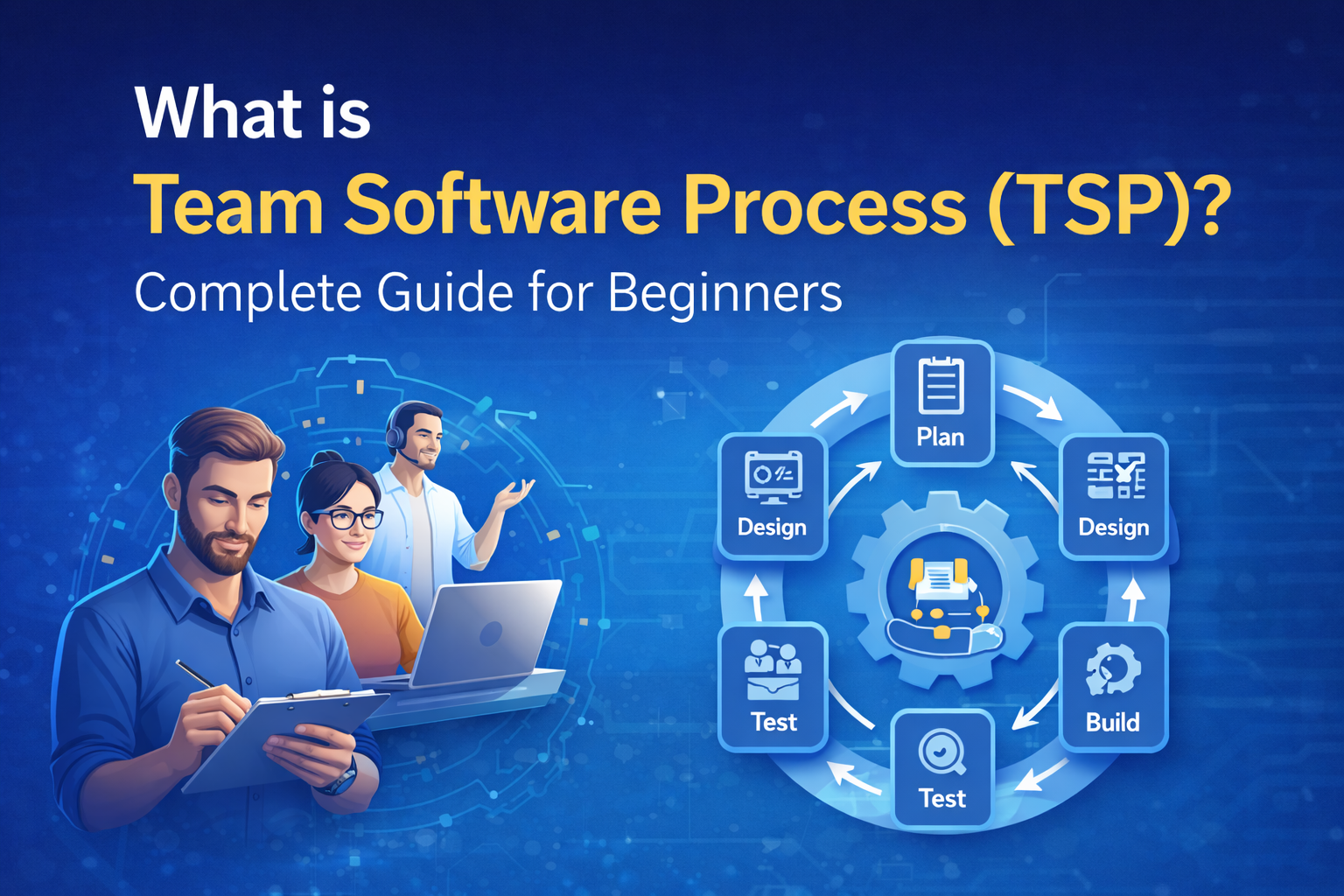
Imagine a 6-person software team building a payroll system. Everyone is coding — but nobody knows what the others are building. Two developers duplicate work. The schedule slips by three months. Quality testing gets rushed. The client is unhappy.
This is exactly the problem the Team Software Process (TSP) was designed to fix. TSP gives software teams a structured, disciplined way to plan their work, assign clear roles, track quality, and deliver software on time — without chaos.
This guide explains what TSP is, how it works step by step, who uses it, and whether it is the right fit for your team — with plain-English explanations and a real-world example throughout.
What is Team Software Process (TSP)?
Team Software Process (TSP) is a structured framework for software engineering teams that defines how a team should plan, build, track, and improve software projects. It was developed by Watts Humphrey at the Software Engineering Institute (SEI) of Carnegie Mellon University in the late 1990s and formally published in 2000.
In simple terms: TSP tells a software team not just what to build, but exactly how to work together to build it well. It covers team structure, planning, quality control, tracking, and self-improvement — all in one integrated process.
Think of TSP like a team playbook in sports. Every player knows their position, the team has a game plan agreed upon together, and after each game they review what went wrong to improve next time. TSP does the same thing for software teams.
Why Was TSP Created?
Before TSP, most software teams had the same recurring problems: missed deadlines, poor quality, unclear responsibilities, and plans that fell apart within weeks. Managers pushed hard, developers worked long hours, but the root cause — a lack of structured team process — was never addressed.
Watts Humphrey had already created the Personal Software Process (PSP) to help individual developers improve their own discipline. But he realized that even disciplined individual developers struggled when working in a team without a shared process. TSP was built to scale PSP principles to the team level.
Key insight behind TSP: Software quality is not just a testing problem — it is a planning and process problem. Fix the process and you prevent the defects before they are ever written.
TSP vs PSP: What is the Difference?
You will often see TSP and PSP mentioned together. They are related but operate at different levels:
| PSP (Personal Software Process) | TSP (Team Software Process) | |
| Scope | Individual developer | Entire team |
| Focus | Your own code quality and time management | Team planning, roles, and shared quality |
| Who uses it | A single engineer working on their tasks | 2–20 engineers working together |
| Relationship | Foundation — must learn PSP first | Builds on PSP, scales it to team level |
PSP = how you manage yourself. TSP = how your team manages itself together. You need PSP before TSP because each TSP team member must already know how to track and manage their own work.
How Does TSP Work? The TSP Lifecycle
TSP works in cycles, each lasting roughly three to four months. Every cycle follows the same structured phases. Let us walk through each phase using a real example: a team building a student enrollment system.
Phase 1: Launch
The launch is the most important phase and what makes TSP unique. A trained TSP coach leads the entire team and management through a structured three-day kickoff meeting. This is not a casual standup — it is a focused process that produces a real, committed team plan.
During the launch, the team:
- Defines clear project goals (e.g., ‘deliver login, enrollment, and reporting modules in 16 weeks’)
- Assigns specific roles to every team member (see roles section below)
- Estimates the size and effort of the project using historical data
- Identifies risks and mitigation plans
- Produces a shared team plan that every member has contributed to and agreed upon
Example: For the enrollment system, the team in the launch meeting estimates that the login module will take 120 hours total. The design manager assigns design tasks, the implementation manager assigns coding tasks, and the test manager defines the test plan — all before any code is written.
Phase 2: Strategy and Planning
After launch, the team creates a detailed execution plan. This includes breaking the project into smaller tasks, estimating time for each task at the individual level, building a weekly schedule, and defining quality checkpoints.
A key element here is that team members plan their own tasks using PSP techniques — so estimates come from the developers doing the work, not from a manager guessing. This makes the plan far more realistic and achievable.
Phase 3: Development (Execution)
During development, the team follows the plan and tracks everything: actual hours spent, tasks completed, defects found, and progress against the schedule. Weekly team meetings review status using real numbers — not just opinions.
Two critical quality practices happen during this phase:
- Code reviews: developers review each other’s code using a structured checklist before it moves to testing. This catches defects when they are cheapest to fix.
- Design inspections: the team reviews high-level designs before implementation begins, catching architectural problems early.
Example: In week 4 of building the enrollment system, the team’s weekly review shows that the login module has taken 145 hours instead of the planned 120. The planning manager updates the schedule, the team discusses why the estimate was off (unclear requirements for password reset), and the scope of remaining work is adjusted. No surprises at the deadline.
Phase 4: Postmortem
Every TSP cycle ends with a postmortem — a structured review where the team analyzes what went well, what went wrong, and what to do differently next cycle. Data collected throughout the project (hours, defects, schedule accuracy) is used to improve estimates and processes for the next cycle.
Example: The enrollment system postmortem reveals that 60% of defects came from the database integration layer. Next cycle, the team adds an extra review checkpoint specifically for database interaction code — preventing the same defects in future modules.
TSP Team Roles Explained Simply
One of the most practical features of TSP is its defined team roles. Every team member has a specific role in addition to their regular development work. This eliminates the ‘I thought you were handling that’ problem.
| Role | Responsibility | Real-World Analogy |
| Team Leader | Coordinates the team, motivates members, manages conflicts | The project captain — keeps everyone rowing in the same direction |
| Planning Manager | Builds and maintains the project plan, tracks schedule | The navigator — knows exactly where the project is vs. where it should be |
| Quality Manager | Tracks defects, monitors review processes, owns quality metrics | The quality inspector — ensures standards are met before delivery |
| Design Manager | Leads technical design, ensures architecture quality | The architect — draws the blueprint before anyone starts building |
| Implementation Manager | Coordinates coding activities, manages code integration | The site foreman — oversees actual construction day to day |
| Test Manager | Plans and manages all testing activities | The safety inspector — verifies everything works before it ships |
| Process Manager | Tracks and improves the team’s processes | The continuous improvement lead — keeps asking ‘how do we do this better?’ |
In a small team, one person may hold more than one role. The key is that every function has a named owner — there are no gaps where critical work falls through.
TSP vs Agile: Are They Competing or Compatible?
Many beginners assume TSP and Agile are opposites — one rigid, one flexible. The reality is more nuanced.
| Aspect | TSP | Agile (Scrum) |
| Planning | Detailed upfront plan per cycle (3–4 months) | Short sprint plans (2 weeks) |
| Quality focus | Prevention — find defects before they are written | Detection — find defects through testing |
| Data driven | Strong — detailed metrics tracked throughout | Light — velocity and burn-down mainly |
| Team structure | Defined roles for each function | Flexible, cross-functional team |
| Best for | Safety-critical, high-quality, predictable delivery | Fast-changing requirements, startup environment |
| Can they coexist? | Yes — TSP practices can run inside Agile sprints | Yes — Agile’s flexibility + TSP’s quality discipline |
TSP and Agile are not enemies. Many teams run TSP-style quality practices (design reviews, defect tracking, structured retrospectives) inside Agile sprints. You get Agile’s speed with TSP’s quality discipline.
Key Benefits of TSP (With Real Data)
TSP is not theoretical — organizations that have implemented it report measurable results:
- Defect reduction: PSP-trained engineers reduce their defect injection rates by 40–50%. TSP’s team-level design reviews reduce this further, resulting in some teams shipping software with fewer than 1 defect per 1,000 lines of code.
- Schedule accuracy: Teams using TSP consistently deliver within 10% of their original schedule estimates — compared to industry averages where projects routinely run 50–100% over schedule.
- Lower rework cost: Finding a defect during code review costs roughly 10x less than finding it in system testing, and 100x less than finding it in production. TSP’s prevention-first approach directly reduces rework expenses.
- Predictable delivery: Because TSP tracks earned value weekly, managers can see at week 4 whether the project is on track to finish on time — not in week 14 when it is too late to recover.
When Should You Use TSP? (And When Not To)
TSP is powerful but not the right fit for every team or project. Here is an honest assessment:
Use TSP when:
- You are building safety-critical software (medical devices, aerospace, financial systems) where defects have serious consequences
- Your team has more than 3–4 developers and coordination is becoming a bottleneck
- Your projects consistently miss deadlines or suffer from poor quality and you want systematic improvement
- Your organization needs predictable, auditable delivery for regulatory or contractual compliance
- Team members have completed PSP training — TSP requires this as a prerequisite
TSP may not be the right fit when:
- You are a small startup team (2–3 people) with rapidly changing requirements — the overhead of a structured launch process may slow you down more than it helps
- Your team has no PSP training — attempting TSP without PSP foundation produces significantly weaker results
- Your project is exploratory or experimental — TSP works best when the scope is reasonably well defined
Frequently Asked Questions About TSP
Do I need to learn PSP before TSP?
Yes — this is a firm requirement of TSP. Every team member must understand PSP before the team can implement TSP effectively. PSP teaches the individual habits (tracking your own time, defects, and estimates) that TSP relies on at the team level.
How large should a TSP team be?
TSP is designed for teams of 2 to 20 members. For larger projects involving up to 150 people, multiple TSP teams can be coordinated in what is called a multi-team TSP structure, where each sub-team operates its own TSP process and a coordination layer manages dependencies between teams.
What is a TSP coach and do you need one?
A TSP coach is a trained facilitator who leads the team through the TSP launch process. They are not a manager or a developer — they are a process expert who helps the team correctly apply TSP, especially when the team is new to it. Experienced teams with multiple TSP cycles under their belt can eventually run launches without a coach, but beginners strongly benefit from one.
Is TSP still relevant in 2026?
Yes — especially in industries where software defects carry high costs or regulatory consequences. TSP’s core principles (team-driven planning, prevention-focused quality, data-based improvement) are more valuable than ever. While Agile has become the default for many product teams, TSP’s disciplined quality framework fills a gap that Agile methods do not fully address — particularly for systems where ‘move fast and break things’ is not an acceptable philosophy.
Summary: TSP in 60 Seconds
Team Software Process (TSP) is a structured framework that helps software teams plan better, build with fewer defects, deliver on schedule, and improve continuously. Created by Watts Humphrey at Carnegie Mellon’s SEI, it builds on the individual discipline of PSP and scales it to an entire engineering team.
The TSP lifecycle runs in cycles: a structured Launch where the team plans together, a Development phase where progress is tracked weekly against real data, and a Postmortem where lessons are captured for next time. Every team member has a defined role, every defect is tracked, and every cycle makes the team more predictable and capable.
It is not the right tool for every team — but for teams building software where quality and schedule predictability genuinely matter, TSP remains one of the most proven and practical frameworks available.
Leave A Comment