
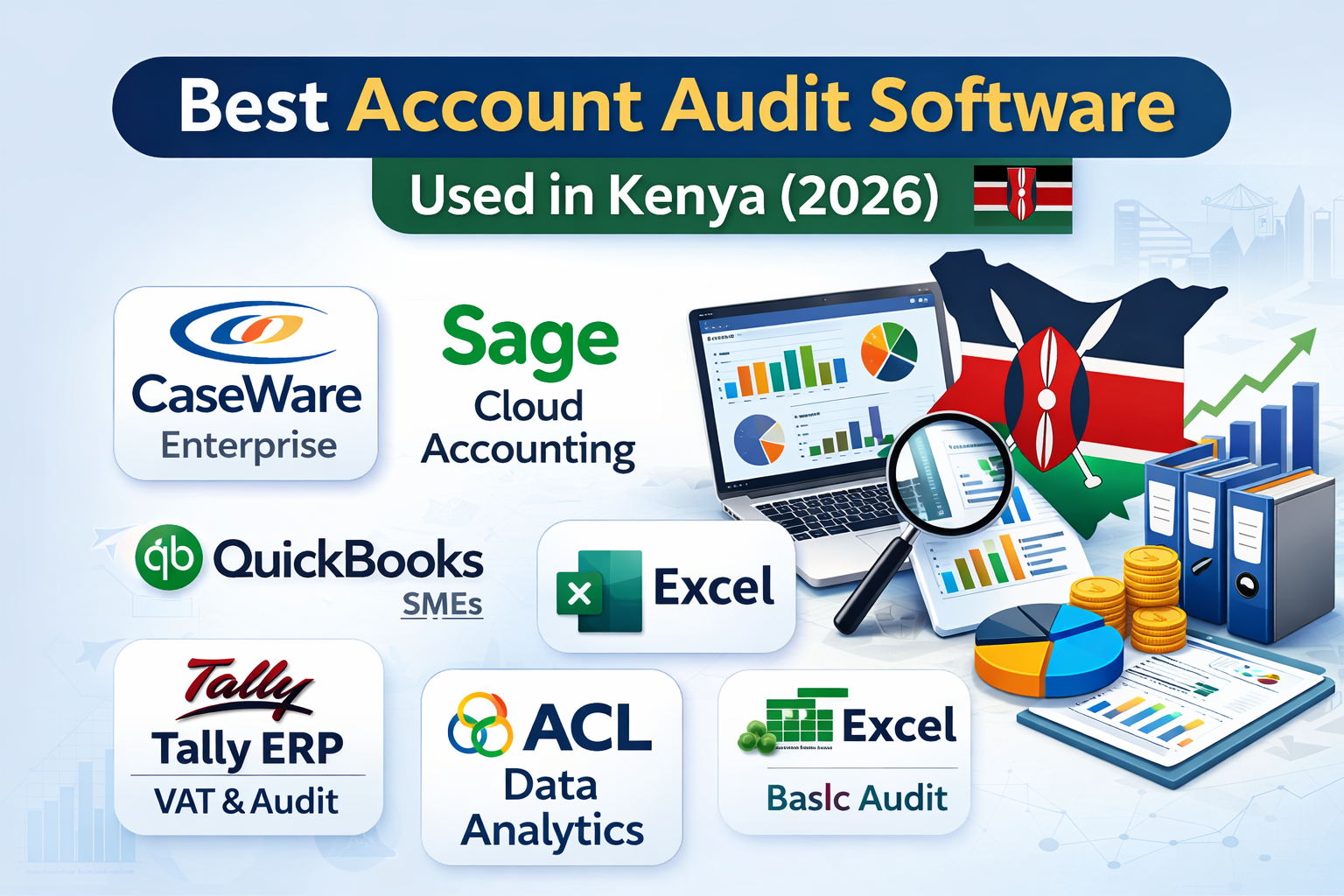
Businesses in Kenya are under increasing pressure to maintain accurate financial records and stay compliant with regulations set by the Kenya Revenue Authority (KRA). Whether you run a small shop in Mombasa or manage the finances of a mid-sized company in Nairobi, using the right common account audit software used in Kenya is no longer optional — it is a business necessity.
In this guide, we break down the most widely used accounting and audit software tools across Kenya, explain what makes each one suitable for the Kenyan market, and help you choose the best option based on your business size, budget, and compliance needs.
What is Account Audit Software?
Account audit software is a digital tool that helps businesses and auditors review financial records, detect errors or fraud, ensure tax compliance, and generate accurate financial reports. It replaces slow, error-prone manual processes with automated workflows.
Common uses of account audit software in Kenya include:
- Verifying financial statements and transaction records
- Preparing reports for KRA tax filing and compliance
- Detecting duplicate entries, fraud, or irregularities
- Supporting internal and external audits
- Ensuring alignment with IFRS standards and local tax laws
Why KRA Compliance and eTIMS Matter in 2026
A major development affecting the choice of common account audit software used in Kenya is the mandatory eTIMS (Electronic Tax Invoice Management System) rollout by the KRA. Under the current ‘No eTIMS, No Deduction’ policy, businesses must ensure that every expense is validated against KRA’s real-time invoice database.
This means your audit software must now support:
- API-based real-time syncing with KRA systems
- Automatic eTIMS invoice validation
- VAT and tax reporting in formats accepted by KRA
- Audit trails that satisfy KRA inspection requirements
Software that does not support eTIMS integration could expose your business to penalties or disallowed deductions. Always confirm eTIMS compatibility before choosing any tool.
Common Account Audit Software Used in Kenya
Below are the most common account audit software tools used in Kenya across different business sizes and industries.
1. CaseWare Audit
CaseWare is one of the most trusted and common account audit software tools used in Kenya, especially among large audit firms and corporates. It is the preferred tool at most Big 4 audit firms and established local practices.
Key Features:
- Automated working papers and financial statement preparation
- Risk assessment and audit documentation
- Compliance with IFRS for SMEs and ISA 230 audit standards
- New in 2026: ESG (Environmental, Social, Governance) reporting modules for NSE-listed companies
Best For: Large audit firms running 30+ engagements per year, Big 4 firms, listed companies
Estimated Cost: Ksh 200,000+ per year for full licenses — best justified at high audit volumes
Limitations: Steep learning curve; new staff typically take 3–4 weeks to become productive
2. QuickBooks
QuickBooks is one of the most widely used accounting tools among small and medium-sized enterprises (SMEs) in Kenya. While primarily an accounting platform, it provides built-in audit trail features that make it a starting point for many businesses exploring common account audit software used in Kenya.
Key Features:
- Detailed audit trail logs for all transactions
- Expense tracking, invoicing, and bank reconciliation
- Financial reporting for audit preparation
- Cloud-based access for accountants and auditors
Best For: Small and medium businesses, freelancers, retail businesses
Important Note: QuickBooks is bookkeeping software with audit-support features — it is not a dedicated audit analytics tool like CaseWare or IDEA.
3. Sage Accounting (formerly Sage Pastel)
Sage has been used across East Africa for decades and remains one of the most common account audit software solutions used in Kenya for medium-sized businesses and professional accountants. Many Kenyan companies run their entire financial management on Sage records.
Key Features:
- Cloud-based accounting with real-time reporting
- Complete audit trail for all financial transactions
- Automated bank reconciliation and VAT reporting
- Tax compliance tools aligned with KRA requirements
Best For: Medium-sized businesses, growing SMEs, professional accountants
Why Kenya Trusts It: Sage has a long-standing local presence and strong support network across East Africa
4. Zoho Books
Zoho Books has quietly gained significant traction in Kenya, especially among Nairobi-based startups and growing businesses. In 2026, it has become one of the leading common account audit software tools used in Kenya for SME eTIMS compliance, thanks to its one-click eTIMS integration setup.
Key Features:
- One-click eTIMS compliance setup for KRA
- Cloud-based, multi-user access for business owners and auditors
- Invoice management, expense tracking, and financial reporting
- Affordable pricing suitable for small businesses
Best For: Startups, service-based businesses, small businesses needing eTIMS compliance
2026 Advantage: Currently considered one of the easiest tools for Nairobi-based SMEs to achieve eTIMS compliance
5. IDEA (Interactive Data Extraction and Analysis)
IDEA is a dedicated audit analytics tool widely used by auditors across Kenya for data analysis and fraud detection. Unlike accounting software, IDEA is built specifically for auditors who need to analyze large volumes of financial data.
Key Features:
- Advanced data analysis: duplicate checking, gap detection, aging analysis
- Fraud detection through pattern recognition
- Risk management and transaction testing
- Handles large datasets efficiently
Best For: Large government audits, fraud investigations, auditors handling complex datasets
Practical Note: Best value when your audit requires complex join operations across massive datasets. For typical SME audits, simpler tools may offer equal results at lower cost.
6. TallyPrime
TallyPrime (the updated version of Tally ERP) remains popular across Kenya, particularly among wholesale and trading businesses. It is favored for its offline-first approach and robust VSCU hardware integration for eTIMS compliance.
Key Features:
- Strong offline accounting with reliable reporting
- VAT/tax management and financial audits
- Inventory tracking integrated with financial records
- VSCU hardware integration for eTIMS compliance
Best For: Wholesalers, distributors, businesses preferring on-premise over cloud solutions
7. SAP Audit Management
SAP Audit Management is used by large enterprises and multinational companies operating in Kenya. It provides enterprise-level audit and compliance capabilities integrated within the broader SAP ecosystem.
Key Features:
- End-to-end audit lifecycle management
- Risk assessment and control testing
- Integration with SAP ERP for seamless data access
- Compliance reporting for international standards
Best For: Large corporates, multinationals, organizations already using SAP ERP
8. ICPAK Audit Software
The Institute of Certified Public Accountants of Kenya (ICPAK) developed its own locally-built audit application specifically for Kenyan accounting practitioners. This is a unique and often overlooked tool in lists of common account audit software used in Kenya — yet it is widely used by local CPA firms.
Key Features:
- Purpose-built for Kenyan audit standards and regulations
- Multi-user access for collaborative audit teams
- Significantly reduces audit preparation time
- First year offered free to ICPAK members
Best For: ICPAK-registered CPAs and local audit practitioners
Where to Learn More: Contact auditsoftware@icpak.com or visit icpak.com for current pricing
9. Xero
Xero is a cloud-based accounting platform popular among startups and modern businesses in Kenya. It is valued for its clean interface and ability to allow multiple users — including external accountants and auditors — to access financial data simultaneously.
Key Features:
- Real-time bank feeds and reconciliation
- Multi-user access with role-based permissions
- Clean financial reporting for audit preparation
- Integrates with hundreds of third-party business tools
Best For: Startups, service businesses, companies with remote accounting teams
Honest Note: Xero has a smaller market footprint in Kenya compared to QuickBooks or Sage — verify local support availability before committing
10. DataSnipper
DataSnipper is an AI-powered audit tool that works directly within Microsoft Excel. It is gaining adoption among forward-thinking Kenyan audit firms in 2026 as a way to modernize their Excel-based workflows without switching platforms entirely.
Key Features:
- AI-powered data extraction from Kenyan receipts and bank statements
- Automatic matching of documents to Excel entries
- Eliminates manual ‘ticking and bashing’ in audit verification
- Works inside Excel — no learning curve for existing Excel users
Best For: Audit firms wanting to add AI capabilities to existing Excel workflows
Comparison Table: Common Account Audit Software Used in Kenya
Use this table to quickly compare your options:
| Software | Best For | Pricing (Est.) | eTIMS/KRA | Audit Type |
| CaseWare | Large firms | Ksh 200K+/yr | Partial | Statutory / External |
| QuickBooks | SMEs | From ~Ksh 3K/mo | Limited | Bookkeeping + audit trail |
| Sage | Medium business | Mid-range | Yes | Full accounting + audit |
| Zoho Books | Startups/SMEs | Affordable | Yes (1-click) | Accounting + eTIMS |
| IDEA | Auditors | High | No (analytics only) | Audit analytics / Fraud |
| TallyPrime | Wholesalers | Moderate | Yes (VSCU) | Accounting + inventory |
| SAP | Enterprises | High | Yes | Enterprise audit mgmt |
| ICPAK Software | CPA firms | Free yr 1 | Yes (local) | Local statutory audit |
| Xero | Startups | Moderate | Limited | Cloud accounting |
| DataSnipper | Excel audit firms | Subscription | No (analytics) | AI-powered verification |
How to Choose the Right Audit Software in Kenya
There is no single best choice — the right common account audit software used in Kenya depends on your specific situation. Here is a practical framework:
By Business Size
- Small business / freelancer → QuickBooks, Zoho Books, or Tally
- Growing SME → Sage or Xero
- Wholesale or trading → TallyPrime
- Large corporate / multinational → CaseWare, SAP
- CPA / audit firm → CaseWare, ICPAK Software, IDEA
By Budget
- Low budget → Zoho Books, ICPAK Software (free yr 1), TallyPrime
- Mid budget → QuickBooks, Sage, Xero
- High budget → CaseWare, SAP, IDEA
By eTIMS / KRA Compliance Priority
- Strongest eTIMS support → Zoho Books (one-click), TallyPrime (VSCU)
- Good KRA alignment → Sage, SAP
- Partial / manual → QuickBooks, CaseWare
One key insight from experienced Kenyan accountants: software choice matters less than implementation quality. A well-implemented affordable tool will outperform a poorly-configured expensive one. Always budget for proper onboarding and staff training.
Common Challenges When Implementing Audit Software in Kenya
Businesses frequently encounter these challenges when adopting common account audit software in Kenya:
- High cost of enterprise tools like CaseWare or SAP relative to SME budgets
- Staff resistance and slow onboarding (CaseWare can take 3–4 weeks to learn)
- Inconsistent internet connectivity in areas outside Nairobi affecting cloud tools
- Data migration difficulties when switching from Excel or legacy systems
- Limited local technical support for some international tools
Most of these issues are solvable through structured implementation planning, choosing a vendor with local support presence, and investing in staff training upfront.
2026 Trends in Audit Software in Kenya
The landscape of common account audit software used in Kenya is evolving rapidly. Key trends to watch in 2026:
- AI-powered audit tools (like DataSnipper) are replacing manual document verification
- Cloud accounting adoption is accelerating, driven by remote work and multi-location businesses
- eTIMS and real-time KRA validation are becoming standard requirements for software selection
- The KRA’s Macho AI system now monitors tax gaps in real-time, increasing pressure on businesses to use compliant software
- ESG reporting modules are being added to enterprise tools for NSE-listed companies
- Smaller firms are moving away from Ksh 400,000+ legacy systems toward smarter, affordable alternatives
Benefits of Using Audit Software for Kenyan Businesses
- Improved financial accuracy and reduced manual errors
- Faster audit preparation — saving days of work each cycle
- Easier KRA compliance and reduced risk of penalties
- Real-time financial visibility for better business decisions
- Secure digital audit trail that satisfies regulatory inspection
- Reduced cost of external audits through organized, clean records
Frequently Asked Questions (FAQ)
What is the most common account audit software used in Kenya?
CaseWare, QuickBooks, and Sage are among the most commonly used. In 2026, Zoho Books and TallyPrime have grown significantly due to their eTIMS compliance features. For professional audit firms, CaseWare and ICPAK’s own software are widely adopted.
Which audit software supports KRA eTIMS compliance in Kenya?
Zoho Books offers the easiest one-click eTIMS setup. TallyPrime supports eTIMS through VSCU hardware integration. Sage and SAP also offer KRA-aligned compliance features. Always verify current eTIMS integration status directly with the vendor before purchasing.
What is the difference between accounting software and audit software in Kenya?
Accounting software (QuickBooks, Sage, Zoho Books) manages day-to-day financial transactions — invoicing, expense tracking, payroll, and reporting. Audit software (CaseWare, IDEA, ICPAK Software) is used by auditors to verify those records, test for fraud, document findings, and produce audit reports. Many businesses use both.
How much does audit software cost in Kenya?
Costs vary widely. Entry-level tools like Zoho Books start at affordable monthly subscriptions. Mid-range tools like QuickBooks and Sage range from a few thousand shillings per month. Enterprise tools like CaseWare can exceed Ksh 200,000 per year. ICPAK’s own software is free for members in the first year.
Does ICPAK recommend any specific audit software?
Yes. ICPAK (Institute of Certified Public Accountants of Kenya) has developed its own audit application available to its members. It is specifically designed for the Kenyan regulatory environment and has been reported to significantly reduce audit preparation time. Contact auditsoftware@icpak.com for details.
Is Excel still used for auditing in Kenya?
Yes — Excel remains widely used for basic auditing, especially among small firms and freelancers. Even the Office of the Auditor General has relied on Excel for basic audit work. However, tools like DataSnipper now add AI-powered capabilities on top of Excel, helping firms modernize without abandoning familiar workflows.
Leave A Comment